Should we be cryopreserving
young cells for longevity?
Back in 2015, I conceived of and co-founded Acorn Biolabs
to make young-cell cryopreservation a real service.
This page is intended to be a fun time-capsule of nostalgic moments that capture my story with Acorn from concept through execution.
As a way to explain the philosophy behind why I believe cryopreserving young cells is a good idea, I wrote a short essay inspired by Blaise Pascal.
Should we be cryopreserving
young cells for longevity?
Back in 2015, I conceived of and co-founded
Acorn Biolabs to make young-cell cryopreservation a real service.
This page is intended to be a fun time-capsule of nostalgic moments that capture my story with Acorn from concept through execution.
As a way to explain the philosophy behind why I believe cryopreserving young cells is a good idea, I wrote a short essay inspired by Blaise Pascal.
Pascal's Bioengineering Wager
The logic behind modern young-cell cryopreservation.
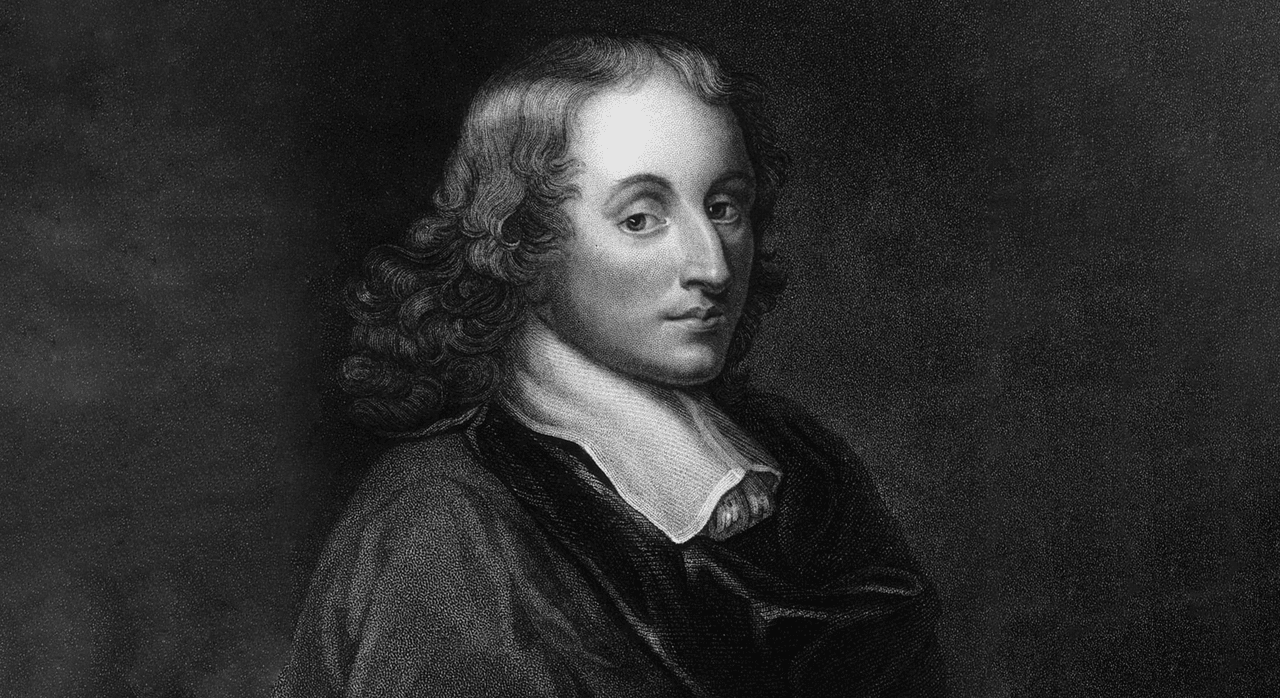
Have you heard of Pascal's Wager?
Blaise Pascal was a seventeenth-century philosopher and one of the few Christian thinkers to invent a purely logical reason to believe in the Christian God.
Pascal neither depended on evidence nor personal revelation. Instead, he noticed that an infinitely positive outcome -- eternity in heaven -- could be secured at the relatively small cost of believing.
While a skeptic may reasonably doubt the existence of God and heaven, no skeptic could reasonably be certain.
God might exist.
Immortality in heaven could be at stake.
One hour of church once a week -- plus tithing -- is a very reasonable price to pay to hedge one's bets -- to wager intelligently in the face of such important consequences.
The case for young-cell cryopreservation
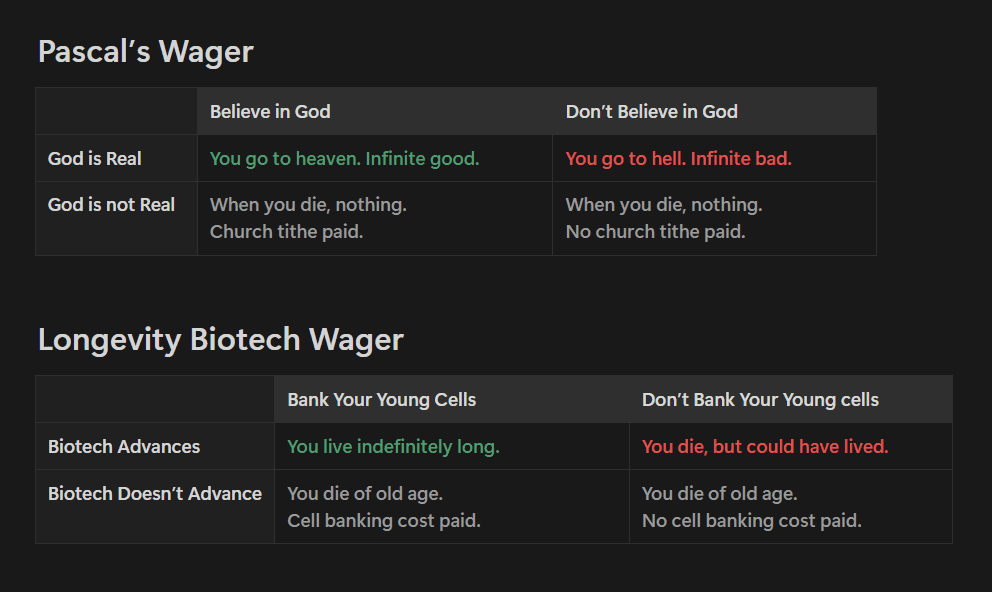
Whether or not Pascal's Wager is actually convincing, the structure of his argument applies perfectly to the question of young-cell cryopreservation.
There are compelling reasons to believe biotechnology is going to continue advancing tremendously in the coming decades and that those advancements may lead to dramatic improvements in human health.
Many of the most promising therapies being developed rely on human cells themselves as the therapeutic. A good example is CAR T-cell therapy: a patient's own immune-system cells are harvested, engineered to be more effective against cancer cells, then reinjected back into the patient. This has actually already been working in practice.
It's possible this trend will continue and that scientists will be able to use people's own cells to grow entirely new replacement organs. It's uncertain, but very much possible.
There's a major problem, though.
As you grow old, your cells grow old with you!
Your own old cells picked off of your own old body will -- almost certainly -- not work well.
Your own young cells would work very well, but how can you access your own young cells after you've already grown old?
The answer is young-cell cryopreservation.
If only people were in the habit of cryopreserving their own young cells while they were still (relatively) young, they'd retain the opportunity to use their own young cells on their own older selves.
What a mouthful, but I'm sure you get it.
The final piece to consider is cost.
Ultimately the variables that matter are the cost of participating, the magnitude of the possible upside, and the perceived likelihood of the upside even materializing at all.
In Pascal's Wager the cost is church-time (and tithing, presumably), the magnitude of the upside is heaven, and the perceived likelihood of heaven materializing is uncertain but possible. Given how incredible the upside of immortality in heaven is, even if the cost is high and the perceived likelihood low, it could still be worth it.
In my young-cell cryopreservation version, the cost to cryopreserve your own young cells with Acorn Biolabs (as of me writing this, Dec 30th, 2025) is $900 upfront + $190 / year, the magnitude of the upside sits anywhere between "possibly saving your life one day" all the way through the possibility of "significantly extending your maximum lifespan" (if biotechnological advancements go really well), and the perceived likelihood of young cells helping you in the future is good but speculative!
So, Acorn Biolabs
Is my young-cell cryopreservation version of Pascal's Wager more or less convincing than the original? It becomes personal to each of us to look at the facts, wrestle with what we believe, prioritize what we want out of life, and assess how much we feel there's a real opportunity for scientific progress to achieve great things with cell-based therapeutics within our lifetimes.
Personally, I'm very convinced it's worth it!
I co-founded Acorn Biolabs with Drew Taylor and Patrick Pumputis back in 2017 to offer young-cell cryopreservation as a real service that has existed out in the real world for about 6 years now.
Do I have my own cells banked? You bet! I was one of the first.
Pascal's Bioengineering Wager
The logic behind modern young-cell cryopreservation.
Have you heard of Pascal's Wager?
Blaise Pascal was a seventeenth-century philosopher and one of the few Christian thinkers to invent a purely logical reason to believe in the Christian God.
Pascal neither depended on evidence nor personal revelation. Instead, he noticed that an infinitely positive outcome -- eternity in heaven -- could be secured at the relatively small cost of believing.
While a skeptic may reasonably doubt the existence of God and heaven, no skeptic could reasonably be certain.
God might exist.
Immortality in heaven could be at stake.
One hour of church once a week -- plus tithing -- is a very reasonable price to pay to hedge one's bets -- to wager intelligently in the face of such important consequences.
The case for young-cell cryopreservation
Whether or not Pascal's Wager is actually convincing, the structure of his argument applies perfectly to the question of young-cell cryopreservation.
There are compelling reasons to believe biotechnology is going to continue advancing tremendously in the coming decades and that those advancements may lead to dramatic improvements in human health.
Many of the most promising therapies being developed rely on human cells themselves as the therapeutic. A good example is CAR T-cell therapy: a patient's own immune-system cells are harvested, engineered to be more effective against cancer cells, then reinjected back into the patient. This has actually already been working in practice.
It's possible this trend will continue and that scientists will be able to use people's own cells to grow entirely new replacement organs. It's uncertain, but very much possible.
There's a major problem, though.
As you grow old, your cells grow old with you!
Your own old cells picked off of your own old body will -- almost certainly -- not work well.
Your own young cells would work very well, but how can you access your own young cells after you've already grown old?
The answer is young-cell cryopreservation.
If only people were in the habit of cryopreserving their own young cells while they were still (relatively) young, they'd retain the opportunity to use their own young cells on their own older selves.
What a mouthful, but I'm sure you get it.
The final piece to consider is cost.
Ultimately the variables that matter are the cost of participating, the magnitude of the possible upside, and the perceived likelihood of the upside even materializing at all.
In Pascal's Wager the cost is church-time (and tithing, presumably), the magnitude of the upside is heaven, and the perceived likelihood of heaven materializing is uncertain but possible. Given how incredible the upside of immortality in heaven is, even if the cost is high and the perceived likelihood low, it could still be worth it.
In my young-cell cryopreservation version, the cost to cryopreserve your own young cells with Acorn Biolabs (as of me writing this, Dec 30th, 2025) is $900 upfront + $190 / year, the magnitude of the upside sits anywhere between "possibly saving your life one day" all the way through the possibility of "significantly extending your maximum lifespan" (if biotechnological advancements go really well), and the perceived likelihood of young cells helping you in the future is good but speculative!
So, Acorn Biolabs
Is my young-cell cryopreservation version of Pascal's Wager more or less convincing than the original? It becomes personal to each of us to look at the facts, wrestle with what we believe, prioritize what we want out of life, and assess how much we feel there's a real opportunity for scientific progress to achieve great things with cell-based therapeutics within our lifetimes.
Personally, I'm very convinced it's worth it!
I co-founded Acorn Biolabs with Drew Taylor and Patrick Pumputis back in 2017 to offer young-cell cryopreservation as a real service that has existed out in the real world for about 6 years now.
Do I have my own cells banked? You bet! I was one of the first.
Digital Memoribilia
Here, nostalgic bits of content from my years working on Acorn:
Pitching Justin Trudeau in Waterloo, 2016
Trudeau was doing a tour of the Waterloo innovation ecosystem, shortly after winning Waterloo's big $25k pitch competition.
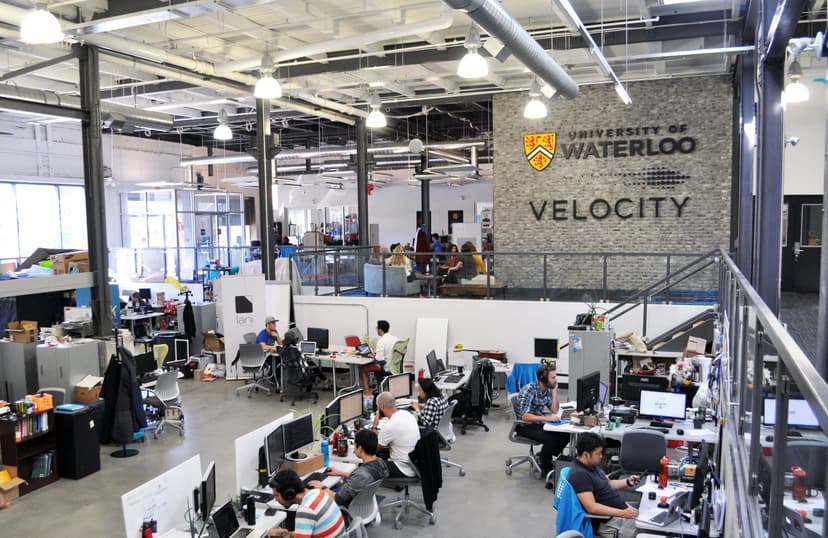
Acorn as an incubating startup in Waterloo, 2017
I gave an interview for a university review podcast (Ten with Ken) on the Velocity startup ecosystem at the University of Waterloo back when I was the CEO of Acorn.
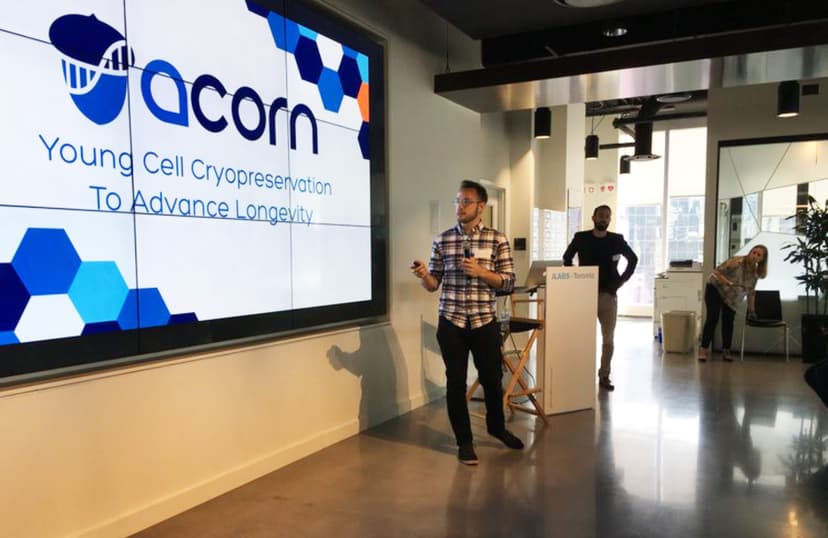
Acorn as post-launch startup in Toronto, 2018
I gave an interview for the podcast "Spotlight on the Six" (Akash Pasricha) on Acorn, bioengineering, the Toronto startup ecosystem, and my transition from CEO to COO of Acorn Biolabs in 2017.
Digital Memoribilia
Here, nostalgic bits of content from my years working on Acorn:
Pitching Justin Trudeau in Waterloo, 2016
Trudeau was doing a tour of the Waterloo innovation ecosystem, shortly after winning Waterloo's big $25k pitch competition.
Acorn in the Velocity Garage, 2017
I gave an interview for a university review podcast (Ten with Ken) on the Velocity startup ecosystem at the University of Waterloo back when I was the CEO of Acorn.
Acorn post-launch startup in Toronto, 2018
I gave an interview for the podcast "Spotlight on the Six" (Akash Pasricha) on Acorn, bioengineering, the Toronto startup ecosystem, and my transition from CEO to COO of Acorn Biolabs in 2017.
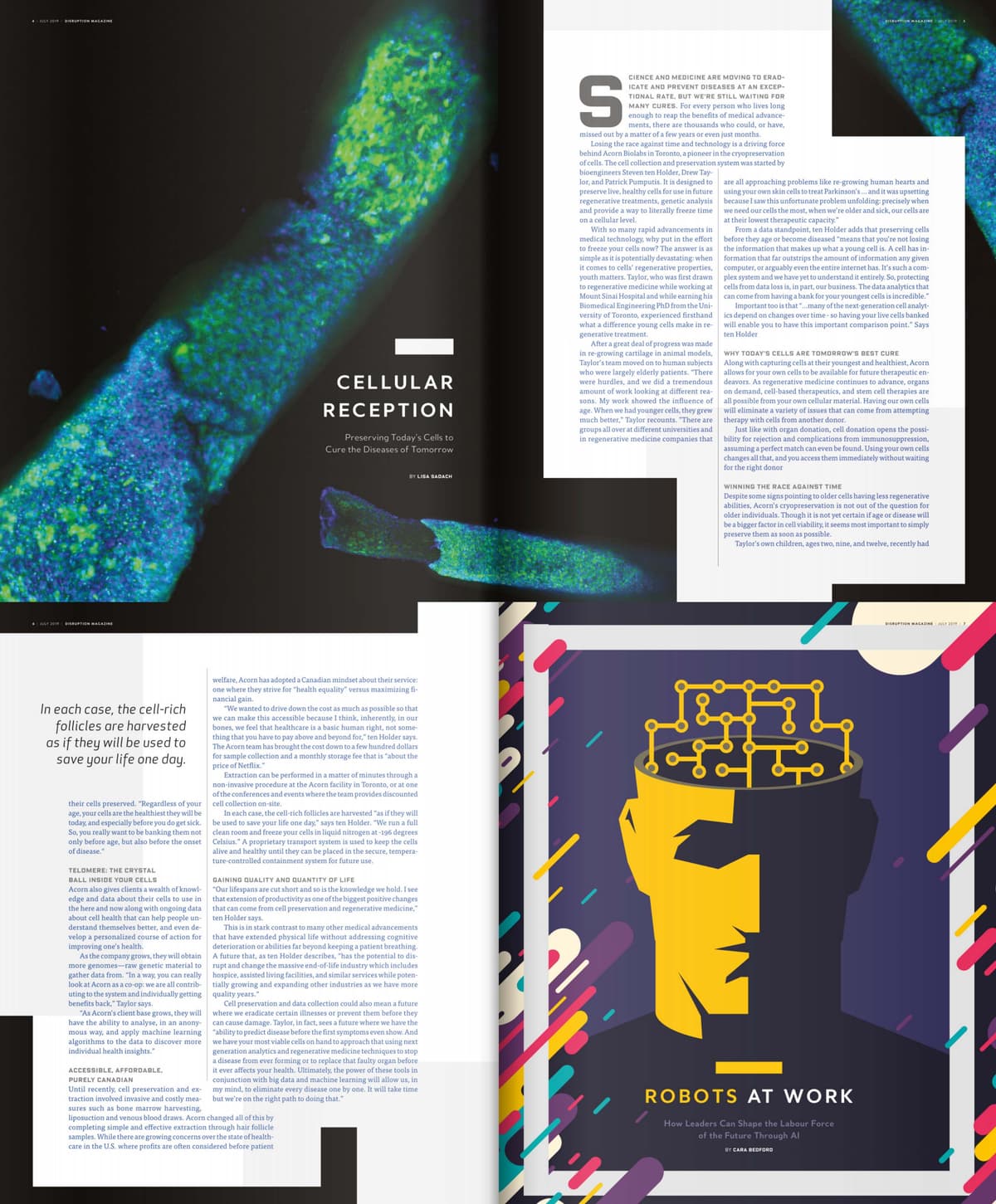
Featured in Disrupt Magazine, 2019
We attended a Singularity University event in Calgary, Alberta where we caught the attention of Disrupt Magazine writers.
(Click image to Enlarge)
Featured in Disrupt Magazine, 2019
We attended a Singularity University event in Calgary, Alberta where we caught the attention of Disrupt Magazine writers.
(Tap image to enlarge and explore)
Discussing Acorn with a TKS student in Vancouver, 2020
I gave an interview for a TKS student podcast "The Daily Experiment" (by Mikey and Mukundh) on Acorn as a concept, bioengineering principles, the philosophy of personality, and more back in 2020.

TKS student interview, Vancouver, 2020
I gave an interview for a TKS student podcast "The Daily Experiment" (by Mikey and Mukundh) on Acorn as a concept, bioengineering principles, the philosophy of personality, and more back in 2020.
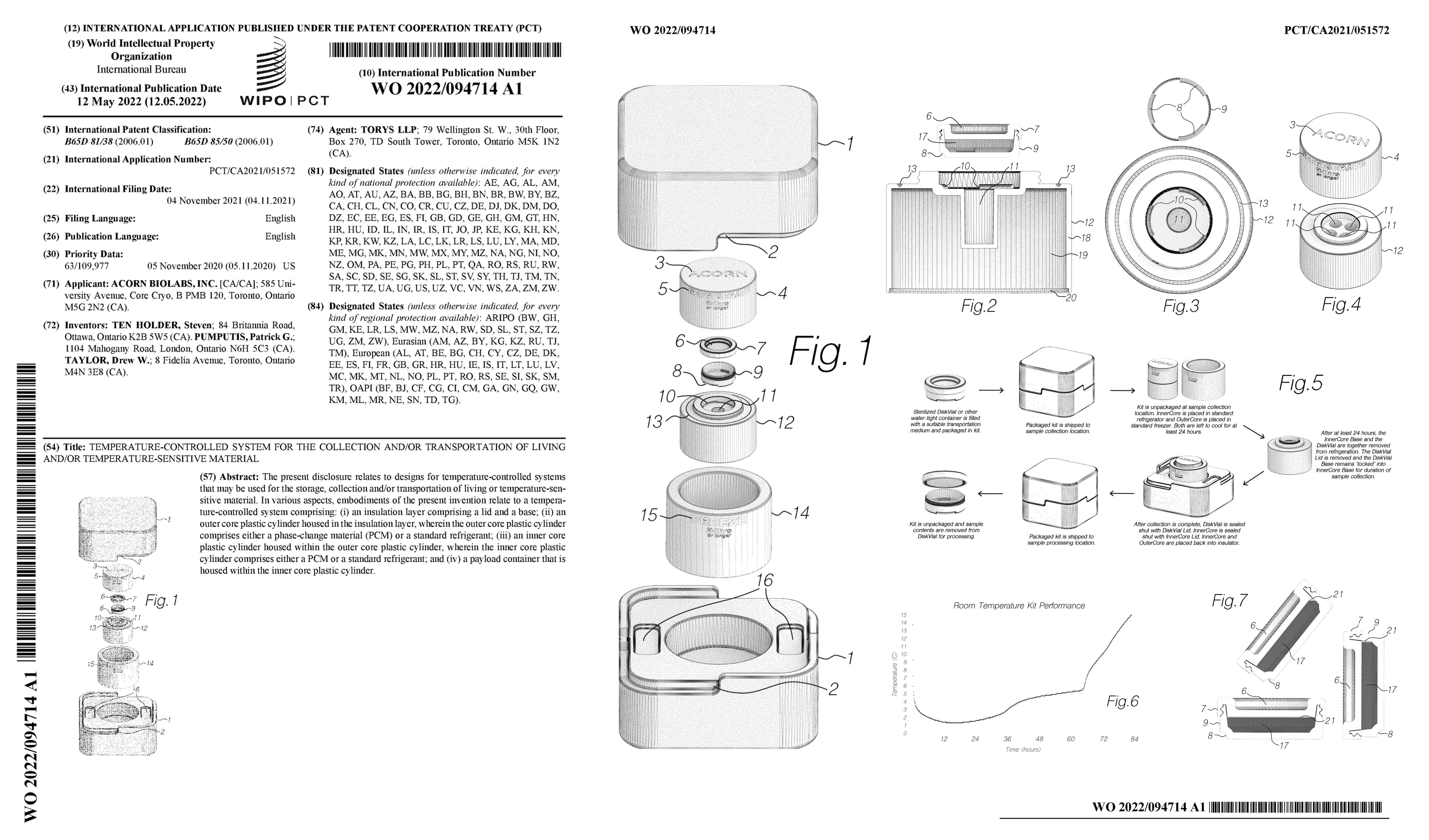
Patent Publication of Transport Kit, 2022
I worked really hard to bring an at-home version of the cell collection process into reality. I led the design and created all of the images you see in the patent. Believe it or not, I used Blender to create all of these! After a few years of design and movement through the patent process, the worldwide patent (WO 2022/094714 A1) was finally awarded to us in 2022.
(Click image to Enlarge)
Patent Publication of Transport Kit, 2022
I worked really hard to bring an at-home version of the cell collection process into reality. I led the design and created all of the images you see in the patent. Believe it or not, I used Blender to create all of these! After a few years of design and movement through the patent process, the worldwide patent (WO 2022/094714 A1) was finally awarded to us in 2022.
(Tap image to enlarge and explore)